This content is also available in: German
Public Transport Atlas reveals large national differences in access to bus and rail services across Germany
A publication of the Agora Verkehrswende think tank examines public transport quality / 30 million people well served; 21 million are poorly served / Social inclusion and climate action require the rapid expansion of public transport services as well as reliable sources of funding
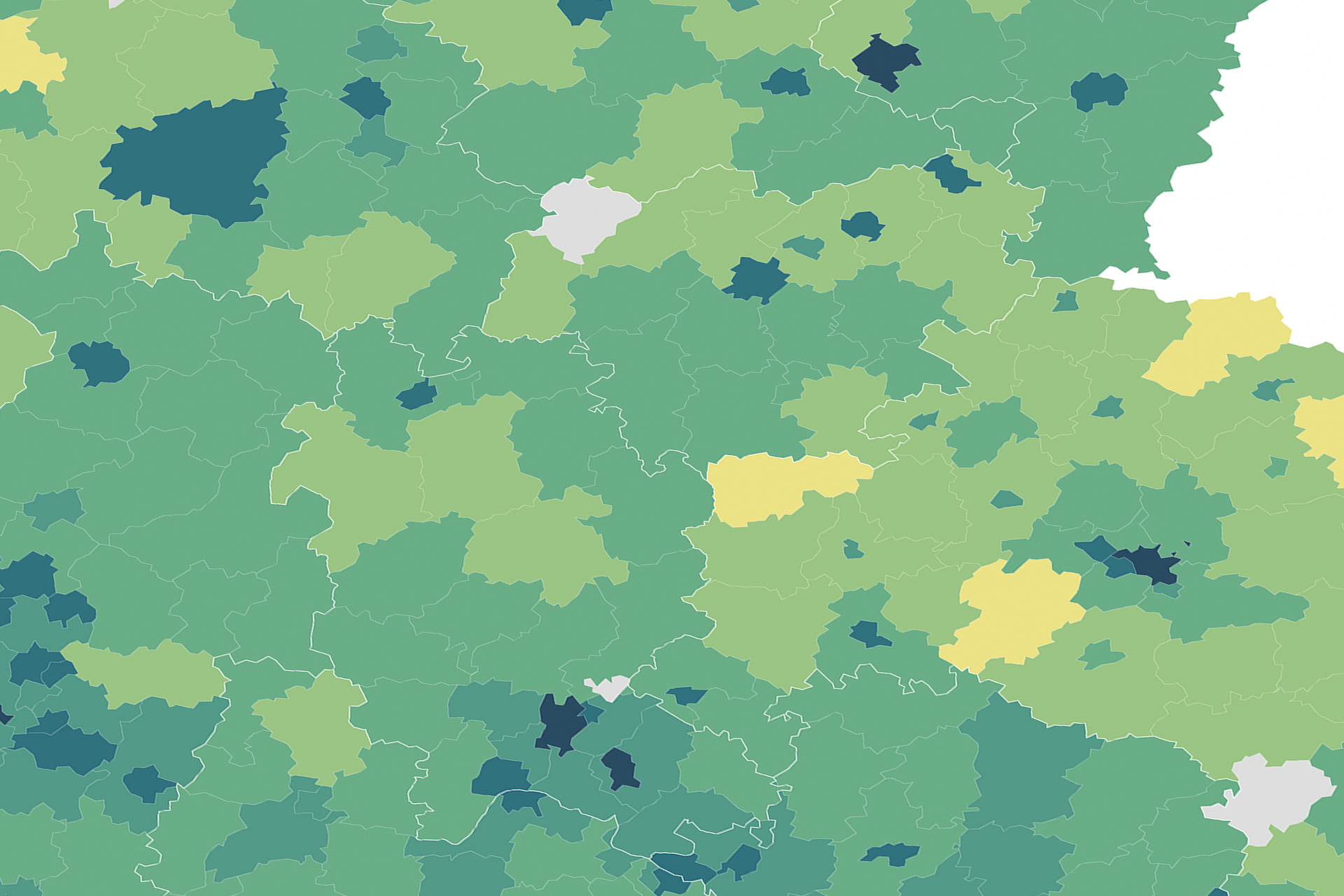
23 September 2026. Access to local public transport services varies widely across Germany. This is the key finding of the Public Transport Atlas, which was published by the Agora Verkehrswende think tank on 1 September. Drawing on up-to-date timetable and population data for every municipality and district in the country, the analysis examines how far people live from a stop or station, which modes of transport are available and how often services run. The resulting service quality grades – ranging from A for best quality to F for the poorest – provide a consistent basis for comparing public transport services nationwide.
According to the atlas, just over a third of the population, around 30 million people, have very good or good access to bus and rail services, corresponding to grades A and B, respectively. Most of these people live in large cities or surrounding areas. By contrast, around a quarter of the population, or some 21 million people, most of whom live in rural areas, lack “good basic access” where they live (e.g. a stop about 250 metres away, with a bus every 30 minutes on working days; this corresponds to grade D).
For 5.6 million people, representing 6,353 of Germany’s 10,747 municipalities, access falls below the lowest grade, F. These residents depend on cars for their transport needs. The municipalities affected are concentrated in Lower Saxony, Schleswig-Holstein, Mecklenburg-Western Pomerania, Brandenburg and Saxony-Anhalt, as well as in Bavaria outside the major urban areas.
“A binding minimum level of service is the first step towards better public transport throughout Germany,” says Wiebke Zimmer, Deputy Executive Director of Agora Verkehrswende. “The federal and state governments can use a mobility guarantee to set such a standard and work together to meet it. Above all, implementation requires reliable funding. Existing funding mechanisms are insufficient. New options should therefore be explored, such as a distance-based road charge for cars and a levy on employers to fund public transport connections.”
Leading cities and districts
On average, service quality rises with population density: the more people a bus or rail route serves, the more economically viable it is to operate. Most people in larger cities are well served, while access is generally poor in rural areas. The Public Transport Atlas therefore compares cities and districts within separate categories.
Among large cities with more than 100,000 residents, the analysis finds that Frankfurt am Main has the best public transport access, closely followed by Stuttgart, Munich, Karlsruhe, Düsseldorf and Darmstadt. Siegen, Recklinghausen, Moers, Wolfsburg and Hamm are the least well served. In this latter group of cities, fewer than one in three residents have good (B) or very good (A) services where they live. All cover a large area, have several centres and lack an urban rail system of their own.
Among districts, those on the fringes of metropolitan areas, such as the area surrounding Munich and Hannover Region, perform best. However, some predominantly rural districts, including Bad Kreuznach, Schwäbisch Hall and Havelland, achieve grade C, despite their low population density.
Among Germany’s states (excluding the city-states of Berlin, Hamburg and Bremen) North Rhine-Westphalia, Hesse and Baden-Württemberg have the highest average service quality. Rhineland-Palatinate has the best balance between urban and rural service quality. Bavaria, Saxony and Mecklenburg-Western Pomerania are characterised by sharp disparities between well-served urban centres and poorly served areas beyond them.
Commuting is essential for cutting emissions
The analysis finds that public transport’s share of the total distance people travel is most closely linked to how well they are connected to local services. Fares, network planning, parking provision and travel habits also play a role. Improving services in places where people are strongly reliant on cars is therefore crucial for reducing emissions.
“To shift as many kilometres as possible from cars to buses and trains, we need good services, particularly along busy commuter corridors between cities and their surrounding areas,” says Philipp Kosok, Senior Associate for Public Transport at Agora Verkehrswende. “In remote areas, public transport can make a substantial contribution to social inclusion – for example, through automated minibuses that operate on demand along flexible routes. Providing good access to bus and rail services is an essential public service and an element of the constitutional mandate to promote equivalent living conditions across Germany.”
Public Transport Atlas 2026
Agora Verkehrswende’s Public Transport Atlas (in German) features a wide range of interactive maps and charts. Previous editions were published in 2021 and 2023.
Related publications
For current recommendations on strengthening local public transport in Germany, see the policy paper Joint venture for the cabinet.
For more on the concept of a mobility guarantee and how it could be implemented, see the analysis A mobility guarantee for Germany (in German).
For more on the potential of autonomous on-demand and fixed-route services, and the barriers to their introduction, see the discussion paper Establishing Germany as a lead market and leading provider in autonomous public transport.
For more on possible funding mechanisms for local public transport, see the press release Additional sources of financing are needed to deliver the sustainable transport system of the future as well as the accompanying German-language study.