This content is also available in: German
Verkehrswende Radar: traffic volumes are up, particularly for leisure purposes
New year-over-year analysis of mobility trends in Germany / Passenger car traffic has almost returned to pre-pandemic levels / Record distances in passenger rail travel
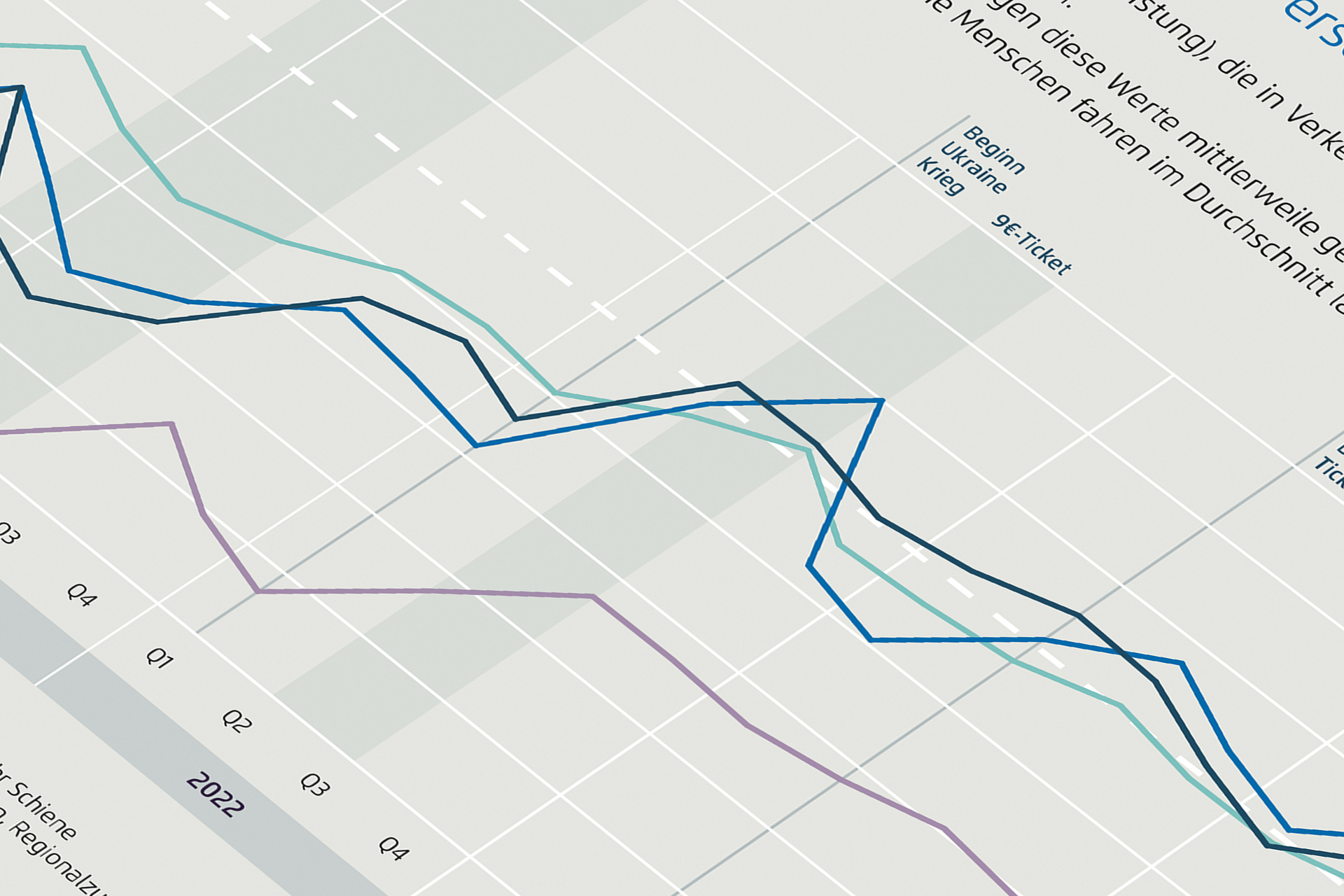
11 June 2026. In 2025 traffic volumes for passenger cars and public transport in Germany almost returned to their 2019 levels. Transport demand thus continued to experience year-over-year growth, after a decline in 2020 during the COVID pandemic. Demand growth in 2025 primarily occurred in the category of journeys for leisure purposes. Meanwhile, commuter traffic volumes remained below their 2019 levels. These findings emerge from the Verkehrswende-Radar, an analysis of transport statistics published as an annual review for the first time in June 2026. The data indicate that while rail journeys are becoming longer on average, cycle traffic remains static, and road freight traffic volumes are falling.
“2025 saw a further year-over-year increase in journey frequency and length. It is becoming increasingly clear that the COVID pandemic interrupted the longterm trend of ever-increasing car traffic volumes only briefly. If we are to come closer to meeting Germany’s climate protection targets, we need a rapid transition to electric vehicles while also making public transport a more attractive alternative to the private car,” says Wiebke Zimmer, Deputy Director of Agora Verkehrswende.
Car traffic volumes now similar to pre-pandemic levels
In 2025, passenger car traffic volumes reached 99 per cent and 97 per cent of their 2019 levels on motorways and federal roads, respectively. However, the distribution of traffic volumes throughout the day has changed. On weekdays in 2025, motorway traffic volumes during peak time were still significantly below 2019 levels. The prevalence of work-from-home arrangements is likely responsible for this trend. However, at midday and on Sundays – when journeys are mainly made for leisure purposes – the 2025 passenger car traffic volumes exceeded their 2019 levels.
In contrast, freight traffic volumes, which are heavily dependent on wider economic development, fell again in 2025 to 96 per cent of their 2019 levels. The Verkehrswende-Radar also monitors bicycle traffic levels, which continued to stagnate in 2025, particularly for everyday use.
Record travel distances by train
In 2025, people used public transport as often – or almost as often – as they had before the decline caused by the pandemic (compared to 2019: local road-based public transport at 98 per cent; local rail-based public transport at 100 per cent; long-distance rail transportat 97 per cent). On average, these trips covered longer distances. Suburban and regional trains saw the biggest increase: Here, transport demand (measured in passenger-kilometres) rose to 114 per cent of the 2019 baseline (the previous record year for which comparable data is available). On long-distance trains, transport demand was at 109 per cent of the 2019 baseline.
“Growth in public transport is being driven primarily by the Deutschlandticket (a countrywide season ticket for local and regional public transport), which makes using buses and trains easier and more affordable. Some of these trips would otherwise have been made by car. This shows that, given attractive alternatives, people are willing to modify their travel behaviour,” says Philine Gaffron, Senior Associate for Mobility and Health at Agora Verkehrswende.
The analysis also covers the EV sector, presenting data on electric vehicle (EV) model availability and the broader growth of the EV market. The range of available EV models has been expanding, not least in lower price segments. The Verkehrswende-Radar also features data and infographics that show the increase in charging-stations and charging-capacity across the country. Increase of the number of fast-charging stations in urban areas has been particularly rapid.
The Verkehrswende-Radar contains a wealth of infographics (in German) and can be accessed free-of-charge here.