Autonomous delivery vehicles: How Germany should prepare for their adoption
Autonomous delivery vehicles are already a common sight on China’s roads – and they may soon be authorised for deployment in Germany as well. Government officials at the federal, state and local levels should work now to set the ground rules for the adoption of this technology.
By Wolfgang Aichinger, Senior Associate for Municipal Climate and Transport Policy
Public discussion of autonomous vehicles in Germany has primarily focused on passenger transport, including how automated robotaxis and shuttle buses can expand existing public transport services. By contrast, freight transport has been largely ignored – despite the potential for particularly rapid adoption in this area of application.
China’s driverless delivery boom
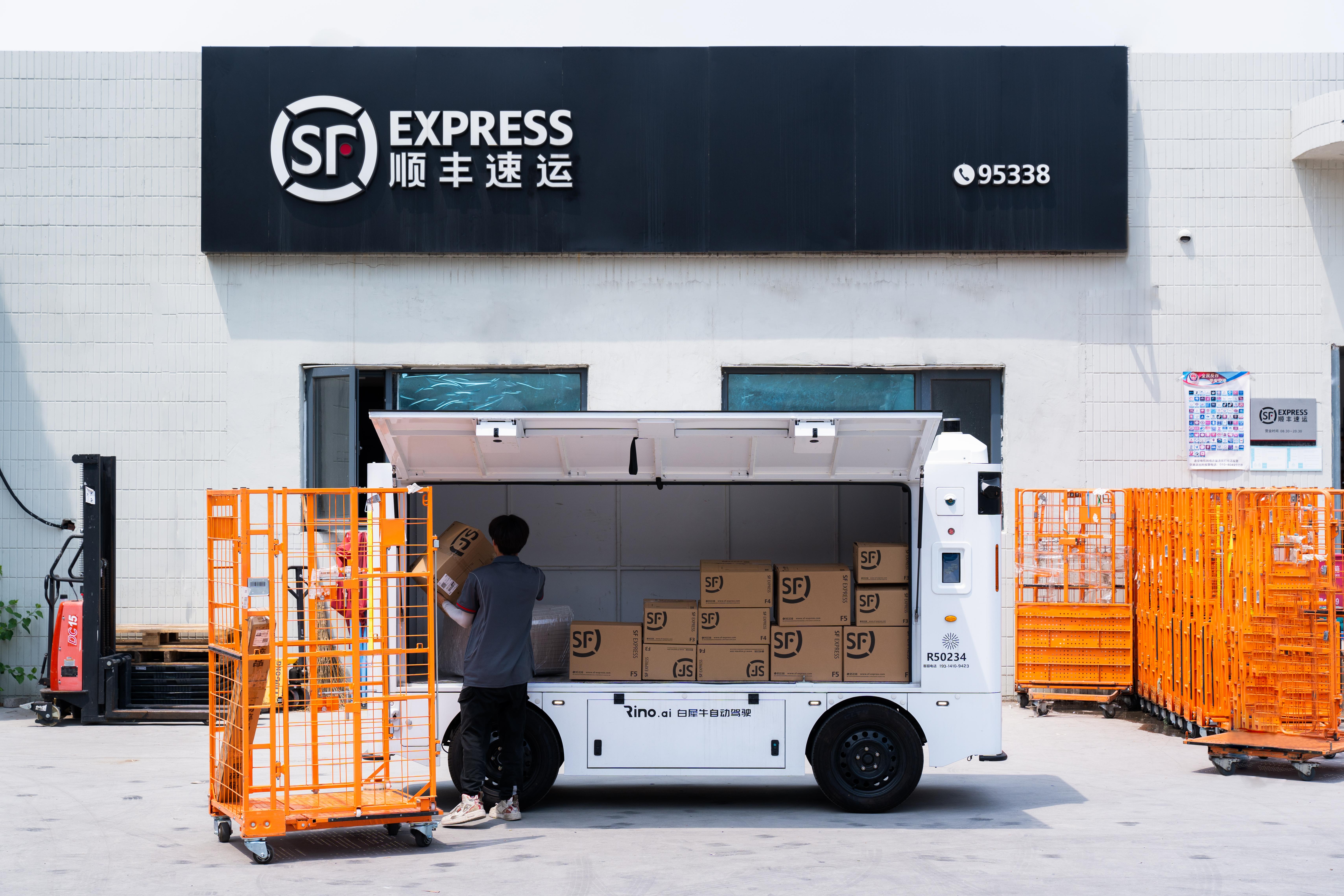
In China, autonomous delivery vehicles represent one of the most mature use cases for self-driving technology. China’s compact autonomous delivery robots deliver goods in urban areas along pre-determined routes. According to the latest figures, there were some 47,000 autonomous delivery vehicles on the road in Q1 2026, and forecasts suggest this figure will rise to 100,000 by the end of the year. More than 200 cities now allow field testing as well as regular operations within specific neighbourhoods and at company sites.
Three cities stand out in terms of early adoption: Shenzhen, a southern Chinese city of approximately 17 million residents, operates a 30 km network of dedicated routes served by over 400 unmanned autonomous delivery vehicles. Suzhou, located west of Shanghai with some 13 million people, established a legal framework for autonomous driving on public roads as early as 2023. Meanwhile, Qingdao, located in northeastern China and home to around 6 million people, is focused on using autonomous delivery vehicles to connect the city with its rural surroundings.
Delivery logistics as a particularly promising area of application
Autonomous delivery vehicles are proliferating with such rapidity in China for good reason: the economic and technological conditions for their operation are particularly favourable. Autonomous delivery robots usually follow fixed, pre-determined routes between distribution centres, parcel stations and collection points. Urban traffic speeds tend to remain low, thus furnishing a suitable operating environment for vehicles with a high level of automation; full automation is not required. Chinese firms report that autonomous vehicles boost delivery capacity while reducing associated costs.
The most significant emissions reductions can be achieved when autonomous delivery vehicles are operated with high loading capacity – for example for transport between logistics along urban peripheries. Reliance on autonomous vehicles for internal logistics at factories, ports and airports can help to reduce local emissions. Furthermore, autonomous vehicles allow expanded delivery-time windows. The associated shifting of delivery times can smooth spikes in transport volumes, thereby easing urban traffic congestion.
First type approvals may soon be possible
The enormous potential offered by autonomous delivery vehicles remains almost completely untapped in Germany. Vehicle testing has only taken place in three cities thus far – Hamburg, Bochum and Göttingen. However, given the advanced technical maturity of these vehicles in combination with declining production costs, manufacturers are expected to seek type approvals in Germany in the near future. The main driver of adoption in Germany is likely to be the growing shortage of drivers in the logistics sector – a shortage that could even jeopardise security of supply over the long term.
Regulatory issues
The existing Autonomous Vehicles Approval and Operation Ordinance (AFGBV) already provides a legal basis for introducing autonomous delivery vehicles on public roads in German cities. The use of sidewalks and bike lanes would require local authorities to grant additional exemptions from road traffic regulations. Yet prior to granting of such exemptions, authorities will need to consider various issues, including impacts to road safety and accessibility, and the needs of pedestrians and cyclists. From Agora Verkehrswende’s perspective, autonomous delivery vehicles should use the roadway, rather than sidewalks, wherever possible. One could also test the shared use of bicycle lanes and other cycling infrastructure.
The introduction of autonomous delivery vehicles could lead to an increase in small-scale delivery traffic while aggravating conflicts over the use of road space. Sustainable logistic solutions that are already well established, such as e-cargo bike services, could come under pressure, given the labour cost advantages of autonomous delivery vehicles.
Coordinated roll-out is essential
Targeted steering will be essential to clarify regulatory questions and balance the various interests impacted by the introduction of autonomous delivery vehicles. The federal government should take the lead on strategic management, developing a regulatory framework in a collaborative process that engages all relevant levels.
In addition to coordinating with municipal officials, the federal government should engage civil-society stakeholders such as pedestrian advocates, road safety groups and accessibility representatives. Federal officials could also consider forming an implementation alliance similar to that being pursued for the adoption of autonomous vehicles in public transport. The integration of autonomous freight transport into Germany’s existing pilot regions for autonomous public transport is another possible action step that merits consideration.
The deployment of autonomous delivery vehicles should be accompanied from the outset by effective regulatory supervision and related intervention mechanisms. The Federal Motor Transport Authority and responsible state and local departments should be granted comprehensive access to relevant vehicle and operational data. Providers should be required to track and transparently log empty trips so that delivery behaviour that is inefficient or aggravates congestion can be financially disincentivized or restricted through regulatory measures. The aim should be to send a clear signal to industry not to implement business models that are designed to generate additional traffic.
Shaping the market of the future
Autonomous delivery vehicles will soon become a reality in Germany. Federal, state and local authorities should thus start setting the ground rules now to ensure the sensible deployment of these vehicles in urban logistics. Crucially, the Autonomous Driving Approval and Operation Regulation (AFGBV) should be operationalized and refined over the near term. This will require incremental field testing, seamless intergovernmental coordination and proactive policy engagement at the municipal level. By taking these steps, Germany can actively shape this future market and establish autonomous delivery vehicles as an element of sustainable and efficient urban logistics.
A German version of the text appeared on 20 July 2026 as a guest article in the newspaper Deutsche Verkehrs-Zeitung.
We have also published a longer version of the text in German, containing even more facts about Chinese manufacturers of autonomous delivery vehicles and about logistics companies in China using them.