-
1.1 Automating the rail sector
1.1 Automating the rail sector
Steps taken to automate the rail sector should be informed by a long-term vision that is actively embraced by local authorities and the federal government. In this context, it is important to distinguish between different application areas, including metro services, regional rail services, and depot operations.
Infrastructure investment must take long-term objectives into account
When a metro line or light rail system nears the end of its service life and replacement investments are being considered, transport planners should systematically assess the potential adoption of automation technologies. The long-term goal of achieving a climate-neutral transport system by 2045 should serve as a key criterion in this regard. Insofar as long-term modal-shift and passenger-growth targets require a significant increase in service frequency, automation levels GoA 2 to GoA 4 may be decisive for achieving necessary capacities.
Pilot projects at depot yards and on secondary lines
Passenger-free operations in shunting areas and depot yards can serve as a starting point for the rail industry to automate light rail networks in cooperation with local transport operators. This is a suitable setting for testing technologies under lower operational risks. Many cities have reported highly positive experiences with driverless underground trains, which are especially effective when combined with fully automated lines.
In the rail sector, it would be reasonable for state-level officials to review secondary lines or reactivation projects with a view to determining their suitability for the testing of driverless rail systems. In regions where demand is lower, automated solutions could help to reduce operating costs without compromising service levels. Automation thus opens up new opportunities for expanding services to niches previously considered problematic for economic reasons. Empirical evidence is still lacking as to whether such solutions actually add value. This is a topic that merits further investigation.
Making ERTMS/ETCS and CBTC the technical standard
The expansion of the European Rail Traffic Management System (ERTMS) remains a prerequisite for a high level of automation in the heavy rail network. The current level of development in Germany is very low. Only two per cent of the rail network complies with European standards. On secondary lines, ETCS can lay the groundwork for driverless operations, while on heavily used main lines it can enable higher-frequency service and increased network capacity.
Railway operators require several years’ lead time when procuring their traction units. The vehicles, track, and associated safety systems are properly viewed as a single unit. To ensure optimal lifecycle management, the rolling stock and line should be simultaneously outfitted with ETCS technology wherever possible. It is therefore necessary to know when each route will be equipped with ETCS.
Due to a lack of suitable applications, no municipal passenger rail vehicles are currently equipped for ETCS operations. Clear, localised, and reliable planning for the rail network remains lacking. An obligation to take action lies first and foremost with the rail network operator DB InfraGO and its owner, the German government. Working in collaboration with state-level governments and the rail industry, the federal government and Deutsche Bahn should flesh out their strategy for modernising signalling and safety systems and the associated retrofitting of the rolling stock. Ensuring sufficient funding is another important task in this area.
If German infrastructure operators and policymakers were to agree on a limited number of standardised control technologies for tracks and rolling stock – such as ETCS for the national rail network and CBTC for urban and underground systems – and pair them with a clear modernization roadmap, the rail industry and other relevant actors would be better positioned to make long-term planning and investment decisions.
Reliable technological roadmaps enable higher production capacities, greater competition between manufacturers and, consequently, lower unit costs. By contrast, current approaches to network modernisation are technologically fragmented and inconsistent, creating significant barriers to efficient industrial production. Divergent systems, small production runs, and unclear investment strategies make continuous production at scale difficult, thus increasing the cost of vehicles and associated infrastructure.
Streamlining the authorisation process
The Federal Railway Authority (EBA) and the European Union Agency for Railways (ERA) should review the authorisation procedures for rail vehicles to identify further opportunities for streamlining and clarification, such as the procedure for demonstrating the safety of driverless trains. With regard to the approval of underground and light rail systems, relevant authorities are currently discussing the possibility of a centralised approval process for all of Germany, administered by a single Technical Supervisory Authority (TAB) in accordance with the Ordinance on the Construction and Operation of Tramways (BOStrab).
However, the valuable expertise that regional authorities possess regarding specific infrastructure assets may be lost in the process. One solution could be for TABs in different German states to mutually recognise granted type approvals; the sole additional requirement would be grid-specific compatibility test. Individual TABs could develop specialised expertise by repeatedly carrying out authorisation procedures in specific application areas (e.g. autonomous driving).
To ease the approval of driverless rail systems, dialogue between regulatory authorities and the rail industry could begin as early as the conceptual design phase. Such collaboration with regulatory authorities would allow clarification of approval criteria at an early stage. This would help rail manufacturers to refine their technological development efforts. Specifically, it would help to mitigate risks associated with uncertain development processes and lengthy approval procedures.
In general, regulatory authorities in Germany place a strong focus on safety, which has made the German rail network one of the safest in the world. Nevertheless, it would be beneficial for Germany’s public authorities to encourage a working culture that is more welcoming of innovation.
Far from merely fulfilling a supervisory role, regulators should view themselves as enablers of innovation. Of course, innovation should never come at the expense of safety. As a general benchmark, automated systems should be required to meet the same safety standards that apply to human drivers.
Ensuring reliable long-term funding
GVFG funding – that is, federal funding distributed to states and municipalities to expand and modernize public transport – is particularly important as a source of reliable long-term funding. By increasing GVFG funding levels, the federal government can meet the growing need for investment in the modernisation and expansion of public transport. This funding instrument is fundamentally suitable for covering a share of the costs arising to automate existing underground and light rail networks, as well as to construct new driverless lines. However, given the large number of infrastructure projects being pursued, current funding levels are insufficient.
Future cost-benefit analyses could assign greater weight to the value of increased transport capacity and improved service quality. Looking forward, it would also be advisable to review potential new sources of financing. France has demonstrated how to allocate a share of railway construction costs to local businesses and tax property value increases attributable to public investment.
Strengthening industrial competitiveness
A strong domestic market is crucial for ensuring the long-term competitiveness of the German and European rail industry – which, as mentioned, is very well positioned in the segment of rail automation. Public procurement and sustained investment can accelerate innovation cycles and enable economies of scale. This will bolster the long-term competitive position of European manufacturers in global markets while also enhancing domestic value creation.
-
1.2 Automating the road sector
Developing a vision for 2035
Germany is at a crucial juncture in the roll-out of autonomous road transport. Regulatory and policy frameworks are in place, and the technology will soon be ready for large-scale deployment.
The key challenge for decision-makers is to implement concrete measures in the face of existing uncertainties. The market for autonomous public transport vehicles is still in its infancy; type-approved vehicle production in series is not yet taking place. While autonomous public buses could help to reduce congestion, particularly on existing routes, on-demand shuttles will initially be offered as a supplementary service, covering routes where there are gaps in coverage or low demand.
A desirable vision for 2035 could be as follows: autonomous shuttles are operating in underserved areas as a supplementary service; standard routes feature automated buses as a means of improving efficiency; planning activities are integrated across all modes of transport; and programmes are in place to ensure equitable career transitions for affected staff. Given reliable funding commitments, clear areas of responsibility, and harmonised standards, large-scale pilot regions can be established over the near term. This would allow Germany to position itself as a lead market for autonomous public transport, thus advancing the mobility transition.
Coordinating processes and establishing standards
With a view to implementing large-scale pilot regions for autonomous public transport, we recommend the selection of up to three regions (with varying population densities). Financing should be assured over the entire duration of the project. The federal government would be responsible for the overall direction of policy, while state-level officials would be responsible for involving local authorities.
The formation of an implementation alliance that undertakes joint procurement would provide public transport companies with the necessary market clout to trigger the mass production of autonomous vehicles, encourage the development of standardised vehicle types and operating procedures, support regulatory approval processes, and reduce risks.
Whenever possible, individual regional initiatives should be geared towards joint, coordinated solutions. Against this backdrop, ongoing dialogue between vehicle manufacturers, software providers, local authorities, and investors will be crucial to align requirements and share knowledge between regions. Standardised skill requirements for remote technical supervisory staff in combination with targeted training and further education programmes would make it easier for employees to transition into new roles and thus increase workforce acceptance.
Simplifying and modernising regulations Germany has already adopted an Autonomous Driving Act and an Autonomous Vehicles Approval and Operation Regulation (AFGBV). Accordingly, a legal framework for the adoption of autonomous vehicles is already in place. As permits for operating in specific geographic areas (so-called Operating Area Approvals) are granted at the state level, approval processes may diverge on a state-by-state basis. To ensure rapid implementation, the process for such permits should be standardised, further developed on the basis of practical experience, and harmonised across the EU.
Extended pre-departure checks mean higher daily workloads and could be automated. Testing passenger operations without onboard safety drivers should be explicitly permitted to enable early evaluation of operational processes and user experience. German road traffic regulations that are designed for human drivers must be reviewed and modified to account for autonomous vehicles. Existing liability rules – namely, product liability rules for manufacturers, and registered keeper liability rules for vehicle owners – also apply to autonomous vehicles. Enforcement of these rules requires data recording obligations (regarding accidents as well as system malfunctions and failures).
Ensuring long-term financing
The widespread adoption of autonomous systems in public transport requires a paradigm shift. Specifically, the current practice of funding individual small-scale projects needs to be supplanted by a significant long-term investment initiative to that supports R&D, the ramp-up of series manufacturing, and the integration of autonomous vehicles in day-to-day operations.
Federal and state governments should establish a centralised fund that incorporates allocations across various departments. This fund should be decoupled from short-term budget cycles while also integrating local authorities within the limits of their budgetary capacities. A coordinated expansion of the autonomous vehicle fleet is essential, as large production volumes are prerequisite for economies of scale and associated cost reductions in production, maintenance, and software development.
Centralised procurement models can play a supportive role in this regard. The regulatory regime and funding schemes should be designed to promote a combination of scheduled and on-demand services, as this improves capacity utilisation, thus making public transport more cost-effective.
At the European level, Germany should advocate for specialised funds (such as the Deutschlandfonds) that mobilise private investment and provide structural support for the autonomous vehicle market. The proposed EU Competitiveness Fund could represent an additional source of funding.
Strengthening safety for all
There are various possible solutions for improving passenger safety, both subjectively and objectively. These include: (1) the establishment of an easily accessible transit operations centre that passengers can directly contact from within the vehicle; (2) easily accessible emergency call options with different levels of urgency, ranging from “I’m feeling unwell” to “I’m in acute danger”; and (3) cameras inside the vehicle.
In addition, reporting options that do not require personal confrontation are necessary – such as a mobile app that allows incidents to be reported discreetly to the transit operations centre. Passengers could be given various ride preference options when booking (e.g. women-only vehicles). Participatory design studies provide examples of how the objective safety situation and its perception can be further improved. These include forward-facing seating arrangements, consistently bright interior lighting, and clear passenger information on safety options.
Compared with conventional public transport, autonomous shuttles offer structural advantages, including direct or nearly direct travel to the passenger’s desired destination, which is particularly beneficial at night. Overcrowding can be prevented by implementing a compulsory seating system. Waiting times at bus stops – which are a key factor in making people feel unsafe – can be reduced through targeted scheduling. In general, the perception of safety depends on a seamless interplay between vehicle design, the ride-booking system, and operations model.
Strengthening the domestic market while safeguarding European sovereignty
Targeted industrial policy can help to strengthen German and European providers while also safeguarding Europe’s technological sovereignty. Germany’s federal and state governments should design large-scale pilot regions such that the outcomes can be applied across Europe on the basis of harmonised standards and mutually determined specifications.
European-made autonomous driving systems should be specifically promoted in order to avoid technological dependence on other regions of the world. The German government should continue to advocate at the EU level for the “Clean, Connected, and Autonomous Vehicles” IPCEI in order to safeguard European value creation and reduce strategic dependencies. Taking a cue from the EU’s Industrial Accelerator Act, preference could be given to European suppliers in public procurement and project funding.
Conclusion
The automation of road- and rail-based public transport is not an end unto itself, but rather a means of achieving the broader objective of a climate-neutral, socially equitable, universally accessible, and convenient transport system. It is crucial to take near-term action in the rail sector by systematic rolling out of ETCS/CBTC and securing reliable sources of funding. By contrast, automating public transport in the road sector requires bolder approach: the current focus on small-scale pilot projects should be abandoned in favour of large-scale pilot regions.
The key technical and legal prerequisites are already in place or are within reach. Crucially, this shift will require a sustained political commitment on the part of government and industry, not only to drive the transformation process, but also to systematically identify and harness associated benefits, including potential synergies between passenger and freight transport. Germany has the opportunity to position itself as a lead market for automated public transport – doing so would strengthen domestic industry while also safeguarding European technological sovereignty. Now is the time to seize this opportunity.
The full version of the discussion paper “Establishing Germany as a lead market and leading provider in autonomous public transport. Opportunities, challenges, and policy options for advancing the adoption of autonomous trains, driverless buses, and on-demand shuttles” is available in German download here.
This content is also available in: German
Establishing Germany as a lead market and leading provider in autonomous public transport
Opportunities, challenges, and policy options for advancing the adoption of autonomous trains, driverless buses, and on-demand shuttles
Preface
Autonomous vehicles have the potential to launch a new era in public transport. Indeed, the manner with which autonomous vehicles are integrated into the transport sector will determine how this technology impacts the broader transition to a climate-neutral transport sector.
Autonomous vehicles could make safe, clean, and convenient mobility accessible to everyone while also generating new market opportunities for the mobility economy. Conversely, the technology has the potential to worsen traffic congestion, increase energy consumption, and drive higher emission levels.
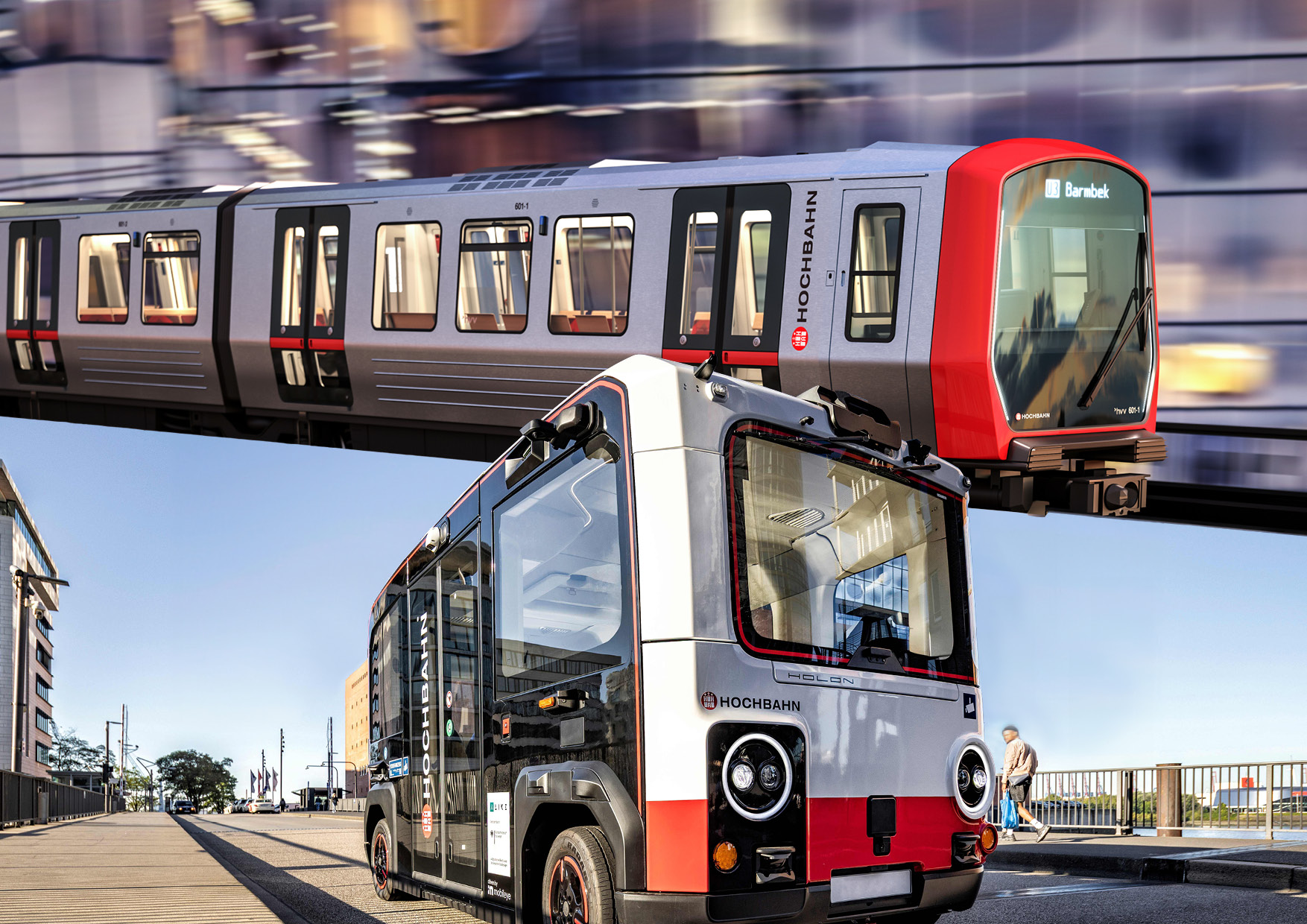
The adoption of driverless road vehicles is gaining steam internationally. Waymo (in the US) and Baidu (in China) provide for over 800,000 autonomous journeys (SAE Level 4) on public roads every week. These companies are expanding their operations and have announced plans to enter the European market. At the same time, rail network automation continues apace. While new underground lines such as the Grand Paris Express and Hamburg’s U5 are being built from scratch for driverless operations, cities such as Copenhagen are comprehensively retrofitting their light rail networks for autonomous trains. In both the road and rail transport sectors, the technology is sufficiently mature for real-world adoption.
However, residual challenges remain, depending on the mode of transport in question: In the area of road transport, a key question is how to adopt the technology on a broad basis while ensuring a public transport system that serves the common good. In the area of rail transport, the technology is already well established; the key challenges pertain to financing and scaling.
In Germany, public transport systems are under severe pressure due to rising costs and staff shortages. Far from doubling public-transport capacity as part of a broader mobility transition, many municipalities are merely struggling to maintain their existing service levels. Automation is increasingly seen as a vital tool
for overcoming structural challenges in the road and rail sectors.
Numerous pilot projects have demonstrated the technical feasibility of road and rail automation, both in and outside Germany. Germany has a strong industrial base, a pioneering regulatory framework, and an understanding of how to integrate autonomous systems into public transport.
Accordingly, Germany has excellent conditions for the broad-based adoption of this technology. The next step is to systematically integrate autonomous systems into the service operations of public transport providers.
The question is no longer whether Germany will automate its public transport systems, but how. It remains to be seen whether Germany will lead the way in this development and become a global lead market for autonomous public transport. This discussion paper seeks to shed greater light on this issue. In addition to defining key terms, we discuss potential benefits for the broader mobility transition, spotlighting practical examples, explain technical and organisational challenges, and propose specific next steps.
Key findings and recommendations
1. Automation is essential for a sustainable public transport system. In the rail sector, highly automated and fully driverless trains offer greater capacity, reliability, and efficiency, and can thus make a significant contribution to the goal of doubling passenger numbers. The potential offered by this advanced technology remains relatively underutilised in Germany. In the area of road-based public transport, driverless on-demand systems can supplement regular services, particularly in rural and remote areas, as well as during times of low demand, thus allowing the public sector to provide a true mobility guarantee. In addition, the development, operation, and maintenance of autonomous systems are creating new jobs for skilled professionals. Training and further education programmes should be implemented at an early stage to account for changing skill requirements.
2. With reliably funded large-scale pilot regions, the transition from test operations to regular service with driverless on-demand minibuses can be successfully achieved. The German government has adopted the right approach by treating Level 4 autonomous vehicles as a complementary element of the public transport system. Large-scale pilot regions in urban and rural areas can now provide crucial insights into the effects of autonomous systems, thus paving the way for integration into regular service operations. By agreeing on the joint procurement of a limited number of vehicle models, public transport operators can encourage more cost-effective production in larger volumes. The federal and state governments should launch an alliance to coordinate regulatory policies, funding conditions, and the integration of autonomous vehicles into existing public transport systems.
3. The automation of public transport represents an opportunity for industrial policy – but the window for action is closing. The technological position of the European rail industry is strong. Targeted investment can consolidate this position in the face of global competition. Autonomous shuttle and bus manufacturing represents a promising new business segment for the automotive industry. The targeted development of several European autonomous driving systems would not only bolster domestic value creation but also strengthen technological sovereignty, which is of strategic importance given international dependencies.
4. The use of modern train control systems will enable the future automation of the rail network. When a railway line is renovated, the choice of train control system determines the line’s capacity for the next 30 years. The automation of underground and light rail systems enables significant increases in capacity. This development route should not be blocked for the sake of short-term cost-savings. Existing funding mechanisms, such as the Local Transport Financing Act (GVFG), are suitable for modernising railway lines and should therefore be further strengthened.
5. The German government and DB InfraGO should present a concrete roadmap for the digitalisation of the rail network. The accelerated roll-out of the European Train Control System (ETCS) is laying the technical foundations for the automation of the heavy rail network. Generally speaking, open networks pose greater challenges than closed systems, but the open approach is well worth the effort. Promising concepts for underused regional rail routes require further investigation. A suitable legal framework for the automation of the heavy rail network is still lacking.
The full version of the discussion paper is available in German here.
Contents
1 | Public transport at the intersection of asset maintenance and expansion
2 | Definitions
2.1 Level of automation
2.2 Types of driverless road vehicles
2.3 The independence of rail systems from private transport
2.4 Public transport’s modal share and associated expenditures
3 | Added value for the mobility transition
3.1 Added value in rail transport
3.2 Added value in road transport
4 | Examples of public transport automation
4.1 Germany
4.2 Europe
4.3 Worldwide
5 | Status quo and challenges to
implementation in Germany
5.1 Technology
5.2 Authorisation and regulation
5.3 Financing and cost-effectiveness
5.4 Structure and organisation
6 | Large-scale pilot regions and an implementation alliance for road-based public transport
6.1 Large-scale pilot regions as an integrated transport system
6.2 Existing initiatives
6.3 An implementation alliance as a coordinated steering mechanism for a common task
7 | Conclusion and next steps for implementation
7.1 Rail sector
7.2 Road sector
Conclusion and next steps for implementation
The German government should systematically place automation on the political agenda across all public transport modes in order to support domestic industry, further climate protection, and ensure a convenient, universally accessible high-frequency mobility system.
Bibliographical data
Downloads
-
Press Release
Harnessing automation as an opportunity for public transport and industrial policy
A new discussion paper by Agora Verkehrswende spotlights the potential offered by autonomous vehicles for a sustainable public transport system / With targeted industrial policy Germany has an opportunity to become a lead market and leading supplier in