This content is also available in: German
Transforming Transport, Ten Years On: Time to Recalculate the Route to the Future? (Episode 3)
The Future of the Automotive Industry in Europe
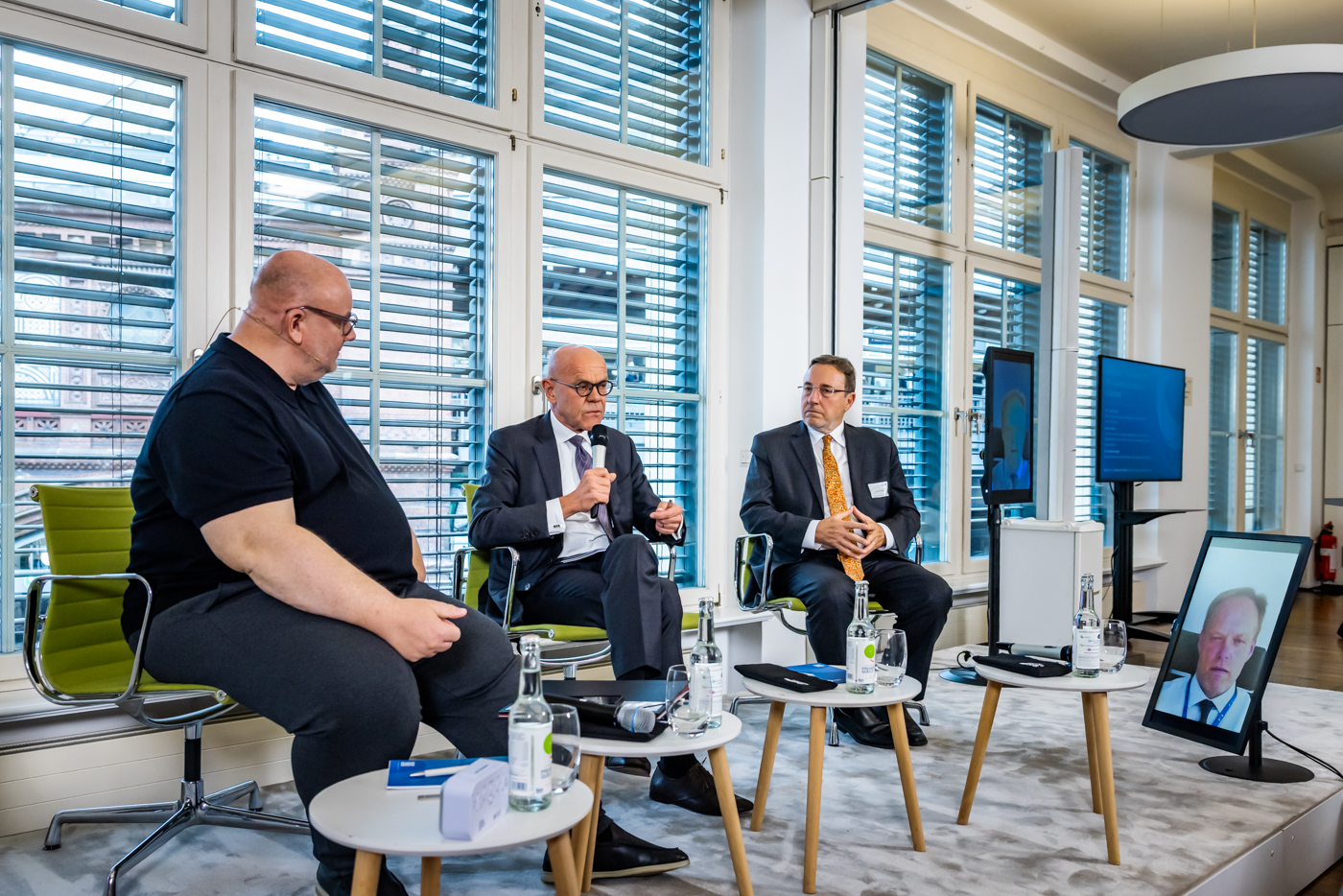
Event Recording
About this event
In the third episode of our podcast series marking the tenth anniversary of Agora Verkehrswende, the focus was on the future of the automotive industry in Europe.
Our guests were:
- Dr. Thomas Steg, General Representative of Volkswagen Group and Head of External Relations,
- Achim Steiner, Chair of the Council of Agora Verkehrswende, Senior Fellow at Oxford Martin School, former Under-Secretary-General of the United Nations,
- Kurt Vandenberghe, Director-General for Climate Action at the European Commission.
Moderator: Christian Hochfeld, Director of Agora Verkehrswende
Some insights from the discussion:
Kurt Vandenberghe stated that there are many reasons for the difficulties of the automotive industry in Europe: first, high energy prices due to Europe’s dependency on oil and gas imports; second, a radically changed world market with strong competition from China; and third, a lack of investments. “Climate policy is not the problem in all this,” he said. To the contrary: “I invite everyone to look at decarbonisation as an agenda for economic modernisation.” In road transport, he pointed out, that means electrification, CO2 fleet standards that guarantee predictability and an automotive industry action plan that ensures competitiveness.
Dr Thomas Steg emphasised Volkswagen's commitment to electrification. Europe has reached a point where “the path to electric mobility is irreversible,” he said. There is a huge market uptake and customers are willing to buy electric cars, especially in the small segment. However, he also made it clear that Volkswagen sees the CO2 fleet standards for 2035 critically. It is crucial, he said, “to find a flexible and pragmatic way to achieve the long-term target. And for us it is not the question to achieve it in 2035. Maybe we need a few years more […]. It depends on the development in the markets.”
Achim Steiner focused on the question of how the costs of the transition are attributed. Countries that are progressing faster, like China, see the opportunity and plan for it, he argued. Europe, on the other hand, puts the transition costs on the bill of the consumer instead of putting them through the public policy system. In his view, this also explains the public policy dilemma in the case of tariffs on products like electric cars that could make decarbonisation cheaper in Europe: “Brussels has to use punitive measures because we are not able to design the technological, systemic and also incentive measures that would actually be far better for everyone and far more politically viable.”
The discussion was part of our 10th anniversary event in Berlin on 1 July 2026. For a recording of the whole anniversary event, including the parts in German (approx. 120 Minutes), please go to the German webpage.
About the podcast series:
Just over ten years ago, in December 2015, the international community ratified the Paris Agreement. Shortly thereafter, Stiftung Mercator and the European Climate Foundation founded Agora Verkehrswende, the Berlin-based think tank for climate-neutral mobility. This year thus marks the tenth anniversary of our founding – and the start of the UN Decade of Sustainable Transport.
Our first publication, Transforming Transport to Ensure Tomorrow’s Mobility (2017), presented a 12-point strategy for decarbonizing the transport sector. This study has informed our activities over the past decade and will serve as a springboard for the podcast discussion.
It is a fitting moment to step back and consider the big picture. In this podcast series, we will converse with thought leaders in the world of sustainable transport, reviewing progress achieved to date while also looking to the decade ahead.
Specifically, we aim to revisit our strategic orientation while considering options for revamping associated policy approaches. Three questions will figure prominently in the podcast discussion: What has been achieved thus far? What challenge did we underestimate the most initially? How can we accelerate progress over the next ten years to achieve a climate-neutral transport sector in Germany by 2045?
Over six episodes, the podcast series will address a range of topics, including urban development and sustainable mobility; electric mobility and industrial transformation; alternative fuels; rural mobility and autonomous vehicles; and infrastructure and sustainable finance.
Future podcast dates will be communicated at the German events section of our website and via the German edition of our newsletter. Please note that only the first and the third episode are in English.
Other episodes in English:
- 5 March 2026: Geopolitics and International Cooperation (Episode 1)
Event details
Transforming Transport, Ten Years On: Time to Recalculate the Route to the Future? (Episode 3)
Agora Online Event
Upcoming events
If you want to receive news about upcoming events, please subscribe to our newsletter.