-
pdf 229 KB
Abb_Africas-EV-policy-landscape_EN.pdf
Around one third of African countries are already taking concrete policy steps towards electric mobility, with at least 22 countries having already adopted strategies or currently preparing them.
A turning point for electric mobility in Africa
On 30 April 2026, African transport and energy ministers endorsed the African Union’s Continental Framework on Electric Mobility.
A turning point for electric mobility in Africa
On 30 April 2026, African transport and energy ministers endorsed the African Union’s Continental Framework on Electric Mobility.
While Africa’s heads of state still need to give final approval, the political message is crystal clear: electric mobility is no longer a set of isolated initiatives at the national level. Rather, it is becoming a shared strategy for the entire continent.
“The African Union’s Continental Framework on Electric Mobility is a turning point that heralds the rise of the electric mobility era in Africa”, says Christian Hochfeld, Director of Agora Verkehrswende. “Given Africa’s growth prospects in combination with its enormous potential in the domains of renewables and critical raw materials, the continent has a tremendous opportunity to leapfrog directly past the era of the combustion engine.”
The policy framework was developed by the African Union Commission in collaboration with the UN Economic Commission for Africa and the UN Environment Programme. It sets out strategic directions for AU member states to accelerate the shift from fossil fuel-dependent transport to electric vehicles.
The case for change is compelling: Africa’s transport sector accounts for 31% of CO2 emissions, and more than 70% of refined fuel demand in Africa is still met through imports.
An increasing number of African countries are turning towards electric mobility: around one third of African countries are already taking concrete policy steps, with at least 22 countries having already adopted strategies or currently preparing them (see graphic below), analysis by Agora Verkehrswende shows.
In practice, AU frameworks, though not legally binding, are often rapidly translated into national legislation. Agora Verkehrswende therefore expects the AU framework to significantly accelerate the uptake of electric mobility.
Agora Verkehrswende has teamed up with the Deutsche Gesellschaft für Internationale Zusammenarbeit (GIZ) GmbH as well as many partners across the African continent to advance electric mobility. In addition to strengthening African think tanks working on climate-neutral transport (e.g. with a fellowship programme), this work includes the identification of critical turning points for change.
The framework was endorsed at the 5th Ordinary Session of the African Union’s Specialized Technical Committee on Transport and Energy (STC-T&E).
To the Press release of the African Union about the endorsement: https://au.int/en/pressreleases/20260430/african-transport-and-energy-ministers-endorse-two-continental-policy
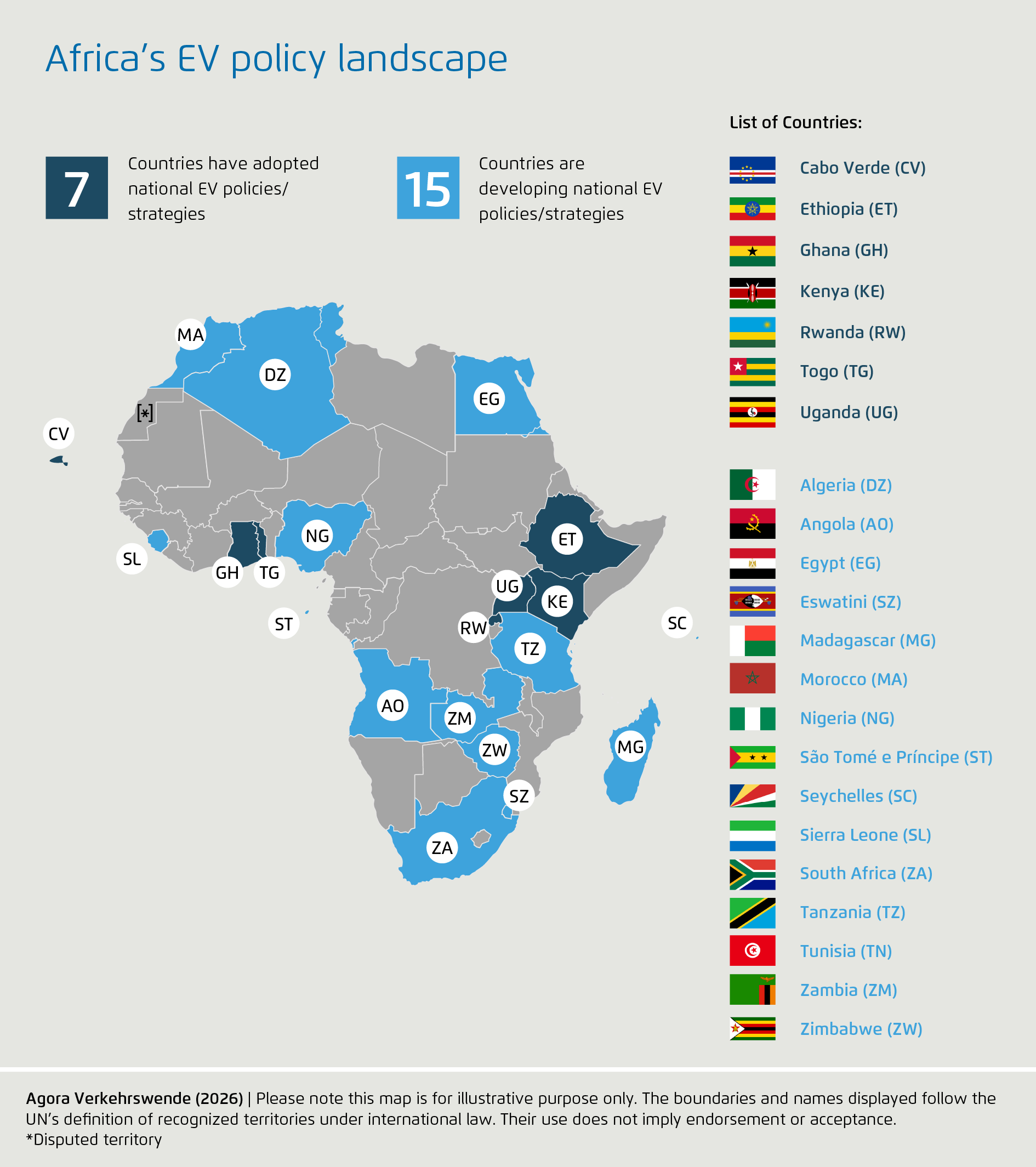
Around one third of African countries are already taking concrete policy steps towards electric mobility, with at least 22 countries having already adopted strategies or currently preparing them.