
This content is also available in: German
Electric mobility: Political hesitation costs valuable time
Infographic by Agora Verkehrswende about the share of electric vehicles in new car registrations in Germany, combined with political measures to promote electric mobility
Analysis by Agora Verkehrswende
Political hesitation has cost Germany valuable time in the market ramp-up of electric vehicles. Conversely, politicians still have a lot of room for manoeuvre to increase the pace. This is shown by a look at the market share of electric vehicles in Germany since 2020 in connection with political measures (see graphic).
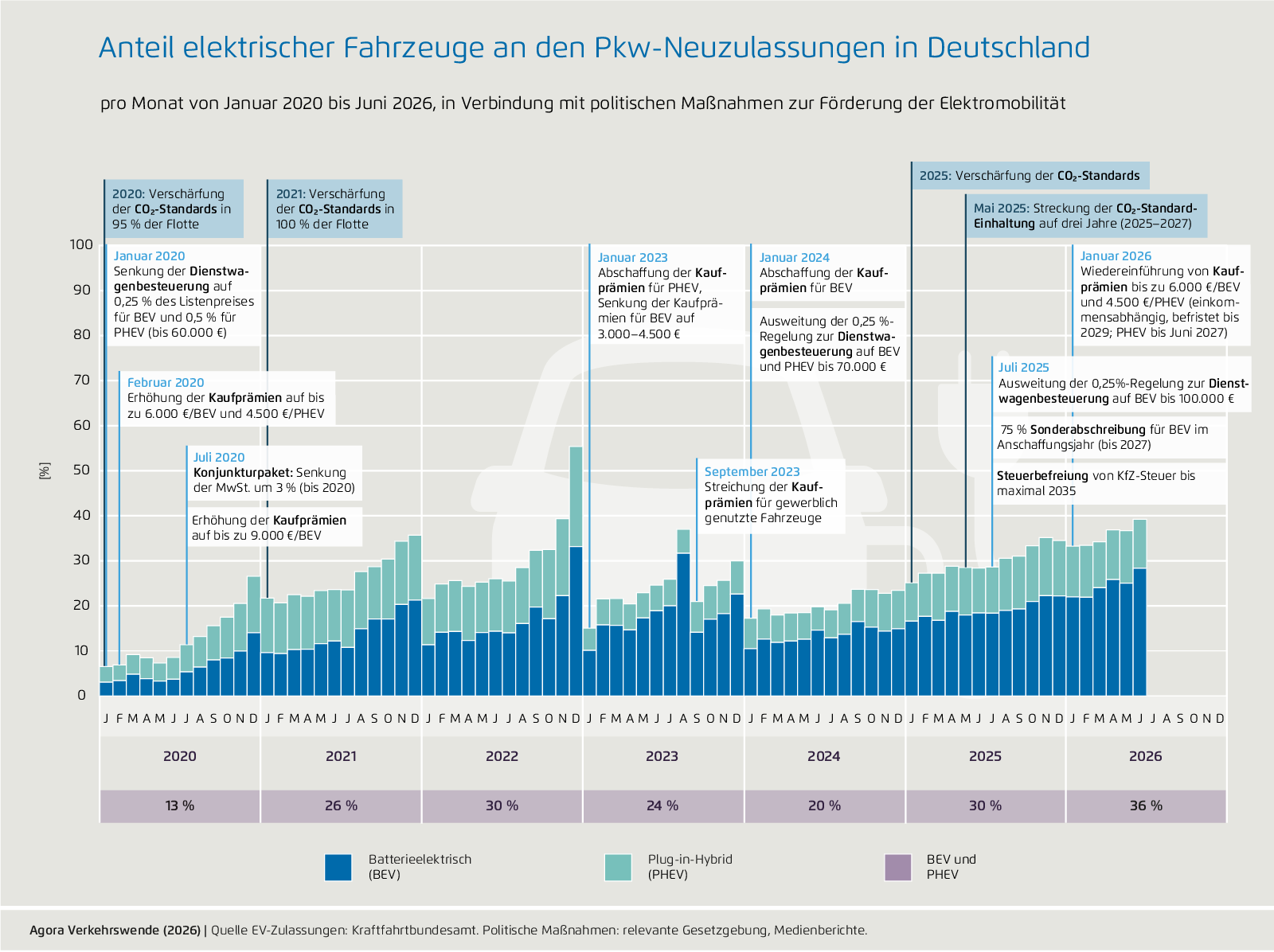
- With the tightening of CO2 standards for new cars and purchase subsidies, sales of electric vehicles picked up significantly from 2020 to 2022.
- The subsequent decline in market share, especially in 2024, was accompanied by the first gradual and then abrupt end of purchase subsidies.
- From 2025, the share rose noticeably again with the next stage of CO2 standards.
- In 2026, renewed purchase subsidies for private cars have given the market a further boost.
Of course, other factors also play a role. For example, the increasing selection of electric vehicle models, the expansion of the charging infrastructure, technical developments, falling vehicle prices, and, most recently, high fuel prices are having a beneficial effect. Conversely, the generally weak economic development and higher inflation rates mean that less is being invested in new purchases.
Yet, especially at the beginning of the market ramp-up of a technology, politics has a great influence – for better or for worse.
Germany has been trying for years to promote the market ramp-up of electric vehicles politically. At the same time, however, the measures are repeatedly called into question and doubts about the technology are spread – for example through discussions about alleged alternatives that are not viable in practice (e-fuels, biofuels, "highly efficient combustion engines"); and by attempts to soften European CO2 standards for new vehicles.
In addition, existing taxes, levies and subsidies do not take sufficient account of the economic costs associated with cars, especially with regard to climate and the environment, for example in the taxation of energy, vehicles or the use of company cars.
This is harmful for Germany as centre of the automotive industry. Consumers, industry and investors are being unsettled. Plans are becoming uncertain, new investments are failing to materialise, past investments are being devalued. The switch to electric mobility is delayed. Established manufacturers continue to lose competitiveness in the markets of the future. The risks to the labour market continue to increase. Dependence on fossil fuels lasts longer.
The best reaction of the federal government would be a clear course towards electric mobility. This applies even independently of the goal to protect the climate. Because in the end, everything else also speaks for electric mobility and for a comprehensive transformation of the transport sector, from competitiveness, jobs, energy security and geopolitics to affordability and quality of life.
The image file can be downloaded here.